Database disk footprint
2025
Databases are widely used throughout the world,. The most popular are relational databases like Oracle, Mysql and PostgreSQL. But also non-relational databases such as Mongodb, Cassandra and Redis. There are many others used in various contexts and various types.
The purpose of this article is to analyse the disk footprint of databases like Mysql and PostgreSQL, also providing a brief comparison with SQLite and MongoDB.
Experimental setup
In this expeirments, we used MySql version 15.1 and PostgreSQL version 15.13 with default settings. We created an empty database with one table name footprint without index. The table has three columns: id, type and footprint. The size in bytes for for the first two fields is respsectively 4 and 5. The fingerprint field stores binary data and its size varies depending on the inserted line.
The definition in SQL of the table is as follows:
CREATE TABLE footprint (
    id INT AUTO_INCREMENT PRIMARY KEY,
    type CHAR(5),
    footprint BLOB
);
CREATE TABLE footprint (
    id SERIAL PRIMARY KEY,
    type CHAR(5),
    footprint BYTEA
);
In the experiments, we insert rows in batches with random data based on parameters such as the blob size. For a total amount of data to insert, we measure the disk footprint in the contents folder the table data.
Parameters studied
We study the impact of several parameters (tab. parameters studied), and in particular the impact on the disk footprint of parameter blob size.
Nom |
Valeur par défaut |
Description |
|---|---|---|
Blob size |
[500, 40000] octets |
Taille du blob |
Batch size |
1 ligne |
Nombre de lignes à insérer puis committer à la fin |
Total inserted size |
1 Go |
Quantité totale de données insérées pour une exécution |
innodb_page_size |
16KB |
MariaDB uniquement : taille de page innodb |
Depending on the experiment, the size of the blob, at each insertion the size may be the same or follow a distribution law with a mean and a standard deviation.
For a comprehensive comparison, we evaluate MariaDB v15.1, MongoDB v8.0.12, PostgreSQL v15.13, and SQLite3 across various scenarios. The execution environment is Debian 12 (bookworm).
Results
Table size growth dynamics
We analyze the growth dynamics of the disk footprint (fig. dynamics), we insert data in batches of rows, in our case the batch size is 1 and the number of bytes per line is fixed. We observe that whatever the size of the blob and the database, the footprint growth is linear.
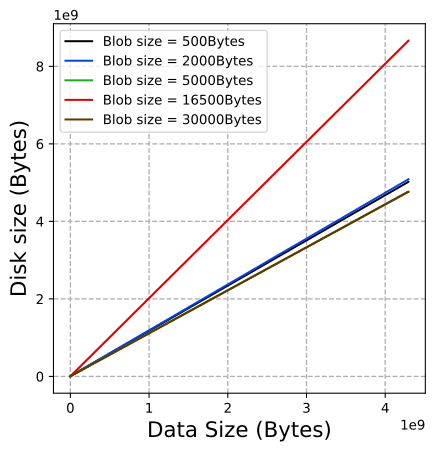
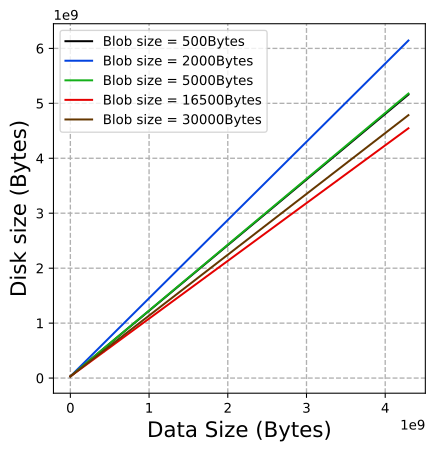
Fig. 7 Dynamique de l’empreinte disque pour différentes tailles de blob, à gauche MariaDB et à droite PgSQL.
Blob field: uniform size
We analyse the impact on the footprint in function of the uniform blob size with total amount inserted data is 1Go. We insert and commit each lines with a spcific blob size.
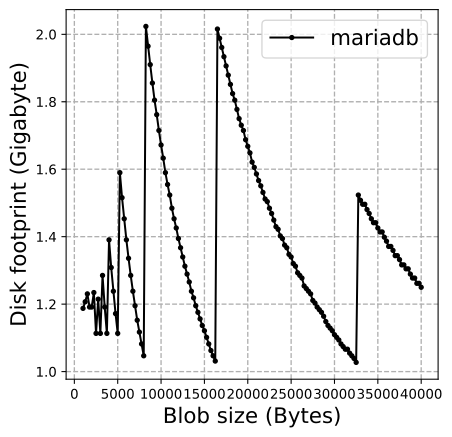
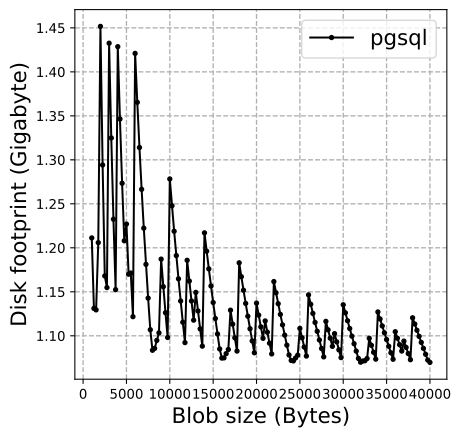
Fig. 8 Empreinte disque en fonction de la taille du blob, à gauche MariaDB et à droite PgSQL.
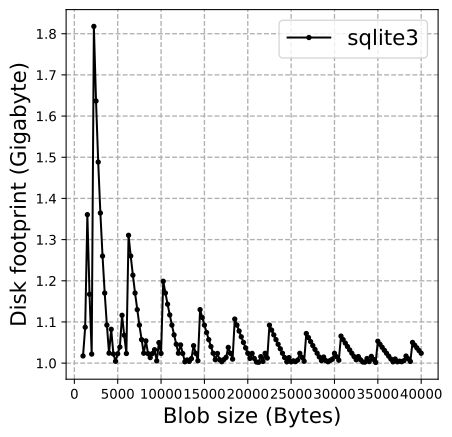
Fig. 9 Empreinte disque en fonction de la taille du blob pour SQLite3.
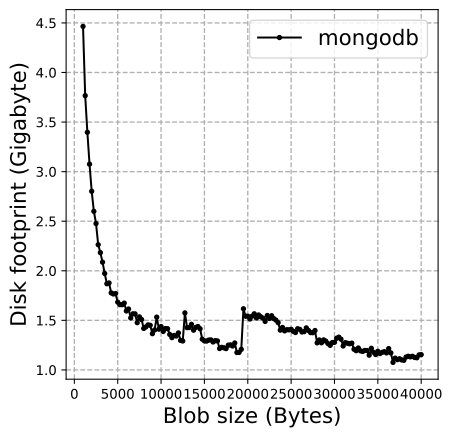
Fig. 10 Empreinte disque en fonction de la taille du blob pour MongoDB.
In function of the blob size, we observe the following elements:
For MariaDB, the disk footprint to a significant impact on specific blob sizes:
5250.For PgSQL, the disk footprint is limited impact especially when the blob size is greater than 8000 Bytes.
Besides, disk footprint variations, disk space consumption for mariadb can be up to double the space compared to the total amount inserted.
MariaDB: innodb_page_size
The innodb_page_size parameter defines the page size for the InnoDB engine. Defaulting to 16KB, it’s recommended, according to the documentation, to align it with your storage device’s block size.
Depending on the innodb_page_size parameter, the impact on disk space varies significantly. For example, with a 5250-byte BLOB and a page size increased from 16KB to 64KB, we can reduce the disk footprint by 26%. However, if this parameter is misconfigured, it can lead to significant disk space over-consumption. This is the case with BLOBs of 16,500 bytes, resulting in a consumption factor of 4.
innodb_page_size |
5250 |
16500 |
|---|---|---|
16 |
1.58 |
2.01 |
32 |
1.28 |
2.03 |
64 |
1.18 |
4.04 |
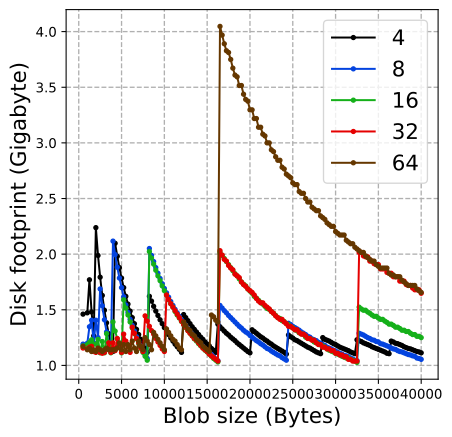
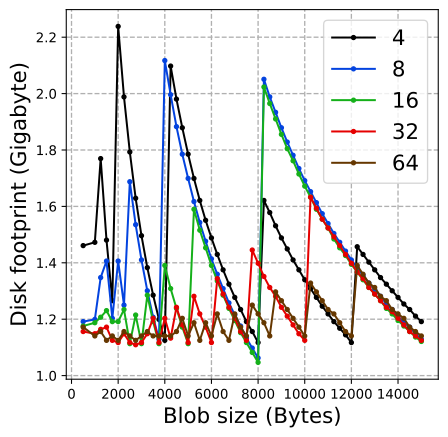
Fig. 11 Empreinte disque en fonction de la taille du blob selon le paramètre innodb_page_size pour Mariadb,
à gauche vue d’ensemble et à droite zoom sur la plage de taille de blob : [500, 15000].
In conclusion, it’s necessary to analyze the distribution of your data samples to effectively determine the optimal value for this parameter, as there is a sensitivity to this parameter that can positively or negatively affect the disk footprint. If the statistical distribution of blob sizes cannot be determined, it is generally best to retain the default or recommended configuration.
Store data in an orderly manner
When we use variable sized blobs, the order in which they are inserted into the table can influence its disk footprint size. In the figure, we notice that a ordered set by blob sizes results in a smaller disk footprint compared to a random ordering.
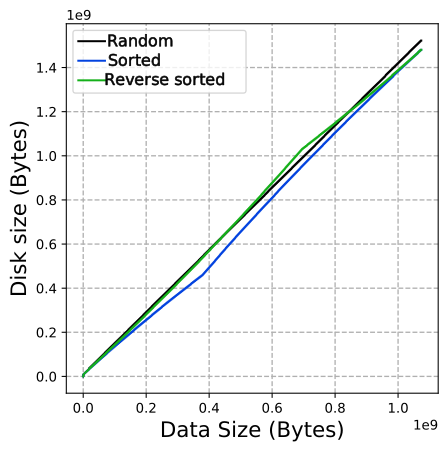
Fig. 12 Dynamique de l’empreinte disque pour un jeu de données à distribution uniforme de la taille de blob entre [4250, 6250] sous Mariadb.
The question we can ask ourselves is whether there is a better ordering relationship that allows us to minimize the disk footprint.
Categorizing Data Storage
As we have seen, storing large volumes of data incurs disk space costs. The storage strategy must therefore be defined based on two main criteria: write requirements and desired access speed, which determine the final cost.
Write requirements create spatial overhead because database systems must anticipate and allocate storage for future insertions.
Access speed, on the other hand, depends not only on physical media (HDD, SSD, NVMe) but also on data structures like indexes, which themselves consume storage space.
        flowchart TD
    %% Style definitions (Paul Tol Palette - Colorblind friendly)
    classDef hotFill fill:#ee6677,stroke:#b53343,color:#ffffff,stroke-width:2px;
    classDef warmFill fill:#cc6677,stroke:#993344,color:#ffffff,stroke-width:2px;
    classDef coldFill fill:#228833,stroke:#114419,color:#ffffff,stroke-width:2px;
    classDef defaultNode fill:#4477aa,stroke:#223355,color:#ffffff,stroke-width:2px;

    A["Need DB Writes?"]:::defaultNode

    A -->|"Yes (OLTP / Frequent)"| B["<div align='left'><b>HOT STORAGE</b><br>• Ex: Redis, PostgreSQL, DynamoDB<br>• Minimal latency < 10ms</div>"]:::hotFill

    A -->|"No (Read-Only / Archive)"| C{"Read Frequency?"}:::defaultNode

    C -->|"High (Analytics)"| D["<div align='left'><b>WARM STORAGE</b><br>• Ex: Read Replicas, ClickHouse, Elasticsearch<br>• Moderate cost & strong read perf</div>"]:::warmFill
    C -->|"Low (Backup)"| E["<div align='left'><b>COLD STORAGE</b><br>• Ex: AWS S3 Glacier, DB Snapshots<br>• Formats: Parquet, ORC<br>• Minimal cost & high compression</div>"]:::coldFill
Tier |
Primary usage |
Typical technologies |
Key advantage |
|---|---|---|---|
Hot Storage |
OLTP transactions, sessions, real-time writes |
Redis, PostgreSQL (NVMe SSD), DynamoDB |
Minimal latency (\(<10\text{ ms}\)) |
Warm Storage |
Reporting, analytics (OLAP), frequent reads |
PostgreSQL (Read Replica), ClickHouse, Elasticsearch |
Cheaper than Hot, strong read performance |
Cold Storage |
History, logs, legal backups, DB archives |
AWS S3 / Glacier, Parquet files, DB Snapshots |
Very low cost per GB, ideal for long-term retention |